Every write-up of the Coffee Pot Bayou path says the same thing: watch for manatees. It's printed like a guarantee, right next to the herons and the pelicans, as if the bayou keeps a rotating cast of wildlife on a fixed schedule. Walk it this week and you'll understand why that line is doing more work than the water can back up. The manatee promise is a winter promise wearing a year-round coat. What's actually reliable in mid-August is a few hundred yards away, and it doesn't swim.
Manatees aren't creatures of habit so much as creatures of temperature. They gather in Tampa Bay's warm-water refuges when the Gulf drops below 68 degrees, and Florida's manatee viewing season for spots like the TECO discharge canal in Apollo Beach runs officially from November 1 through April 15. One regional wildlife roundup even names a Coffee Pot Boulevard NE location in St. Petersburg specifically as a winter sighting spot, the kind of detail that only shows up when the water is cold enough to push manatees into predictable, visible clusters. Right now, in August, the bay is warm everywhere. Manatees don't need to crowd into the bayou to survive the night. They're spread across open water chasing seagrass, which means a sighting on your morning walk is a coin flip, not a checkbox.
So the walk isn't wrong. The expectation is.
What the path actually is
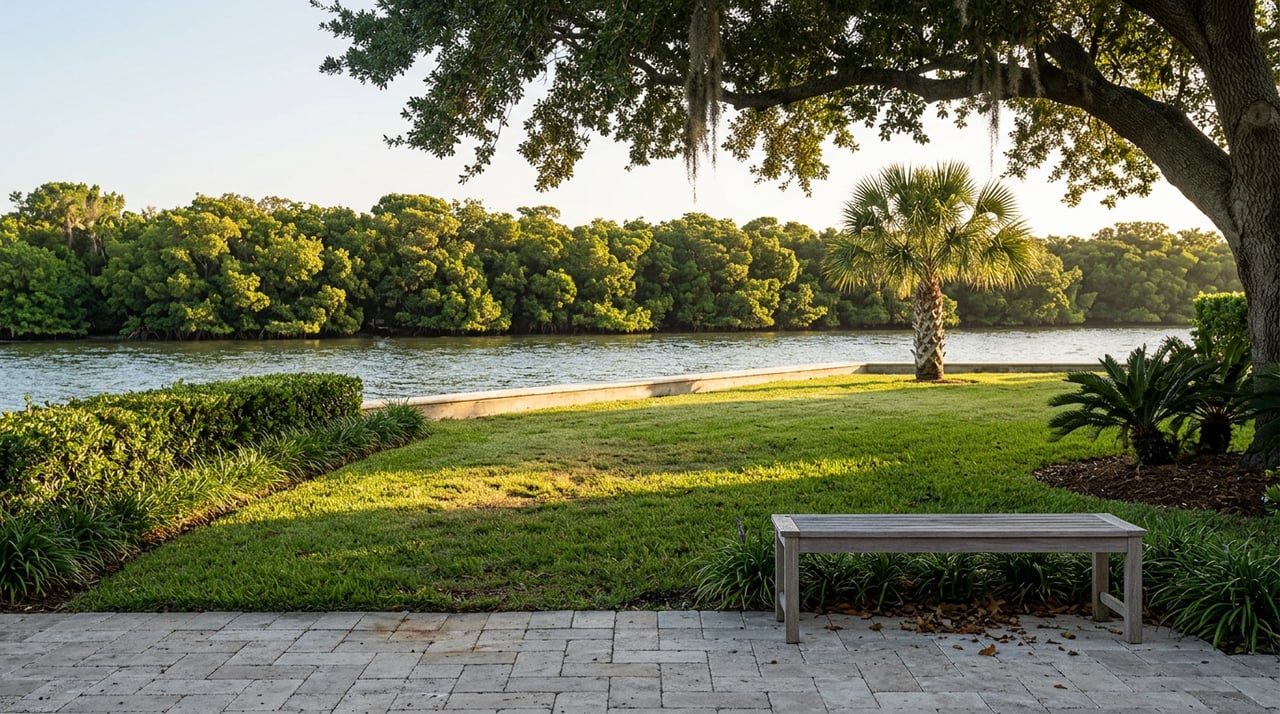
The route itself is a two-mile stretch of sidewalk along North Shore Drive, running from downtown out through North Shore Park and into the bayou proper. It's wide, it's lit at night, and it faces the water in a way that makes early morning the best time to be on it, when the light comes up low and gold across the bay instead of glaring straight down. There are benches spaced along the way for anyone who wants to stop and watch the water rather than keep moving, and a small beach access point off North Shore Park where the path briefly opens onto sand. Locals fish from stretches of it too, particularly near the park, where the shoreline gives enough clearance to cast without competing with boat traffic.
None of that requires a manatee to be worth doing. But if you came expecting one and left disappointed, you were looking in the wrong direction.
The reliable show is a few hundred yards south
Just past the Snell Isle Bridge, tucked into the bayou, sits a small mangrove island that doesn't allow people on it at all. It's known locally as Bird Island, and unlike the manatees, its residents don't leave for the summer. You can catch a glimpse of it from Coffee Pot Boulevard, but the real view is from Brightwaters Boulevard on the Snell Isle side, or by boat, since Coffee Pot Park has a public launch that gets you there in a few minutes, passing directly under the bridge.
What's on the island is dense and loud in the way only an undisturbed rookery gets. White ibis roost alongside blue herons, green herons, and tricolored night herons. Roseate spoonbills show up often enough to be worth watching for, and brown pelicans dominate by sheer numbers. A biology professor at Eckerd College who lives nearby and studies the area's birds has explained why the density holds up so well.
"There are no terrestrial mammals. There are no raccoons or coyotes."
No land predators means no nest raiding, which is rare for a piece of undeveloped shoreline this close to a dense residential neighborhood. It's also why the island stays loud at almost any hour, morning, evening, sometimes midday, in a way the water itself, empty of manatees for most of the year, simply doesn't match right now.
The bridge you're already crossing
The bridge that gets you within sight of all this has its own story, and it's worth knowing before you walk under it for the tenth time without a second look. The current Snell Isle Bridge dates to 1931, built in a style modeled on Renaissance Venetian bridges. It exists because C. Perry Snell, the developer who shaped the island in the 1920s, donated land north of the crossing to the St. Petersburg Women's Club in 1928. The club wanted a better bridge than the rickety wooden one that had connected Old Northeast to Snell Isle since 1917, and they pushed the city to help fund it alongside Snell. It opened on Christmas Day, 1931.
A few other landmarks anchor the same stretch if you're mapping the route in your head:
- North Shore Park, a 33-acre waterfront space with a beach, dog park, tennis courts, a softball field, and the North Shore Aquatic Complex, which stays open year-round for lap swimming and public hours
- Coffee Pot Park, sitting between 30th and 31st Avenue NE, home to the public boat launch that gets kayakers and paddleboarders to Bird Island without a long paddle
- The Snell Isle Bridge itself, the visual hinge of the whole walk and the point where downtown gives way to the quieter, tree-lined streets of the isle
None of these change by season. They're the fixed part of the walk, the part every guide gets right because there's nothing to get wrong. The wildlife is where the seasonal nuance actually lives, and it's the part most write-ups skip past.
Timing it right
If you're walking for the light or the birds rather than a maybe-manatee, timing still matters. The path has almost no shade at midday, and Florida sun in August is not something to underestimate on a two-mile round trip. Early morning solves two problems at once: it's cooler, and it's when Bird Island is loudest, since herons and pelicans are most active feeding at dawn. The path also narrows in a few spots where mature palms crowd the sidewalk, which becomes more noticeable once joggers, cyclists, and the occasional skater are all sharing the same six feet of concrete. Go early enough and you mostly avoid that crunch entirely.
None of this is a knock on the manatees. They're worth watching for from December through March, when the odds genuinely favor a sighting and the bay's colder water pushes them into exactly the kind of visible clustering that makes for a good photo. Right now, in August, they're just not the story. Adjust the expectation and the walk gets better, not worse. You stop scanning the water for something unlikely to appear and start noticing the bridge, the island, the birds that never left.
That's the difference between a guide written from a spreadsheet of amenities and a walk understood by someone who's actually done it in every month of the year. The bayou doesn't owe you a manatee in August. It owes you a rookery that's been loud since before anyone built a bridge to see it from, and it delivers that every single morning.
If you're the kind of person who notices details like this about a neighborhood, chances are you already know your way around Snell Isle better than most guides give you credit for. Kym Coyle works this stretch of St. Petersburg year-round, and if you're ever curious what that local knowledge means for your own address, her site offers a free instant home valuation whenever you want a starting point.
